How to Pause an Impulse Purchase Without White-Knuckling Willpower
You’re not weak—you’re running on decision fatigue and dopamine loops designed to hijack autopilot. Instead of fighting the urge, screenshot the item and close the tab; that tiny ritual gives you the hit without the damage, and most screenshots lose their charge within days. Or try the ten-item rule: add everything to your cart, which dissolves the scarcity panic because permission removes urgency, and abundance creates choice dilution that drains emotional charge. The trick isn’t willpower—it’s creating friction that lets your rational brain catch up to your impulses, and there are specific ways to build that pause into your process.
What you will leave with
- Screenshot the item and close the tab to satisfy the dopamine hit without purchasing, creating a natural 24–48 hour pause.
- Transfer the item’s price to a cooling-off fund and schedule a 30-day reconsideration reminder—most urges evaporate by day fifteen.
- Remove saved payment methods to force manual card entry, turning typing sixteen digits into an intentional decision checkpoint.
- Fill your cart with ten-plus items to eliminate scarcity panic; abundance creates choice dilution that reduces each item’s emotional charge.
- Use temporal reframing—”not now, maybe later”—to give permission to want without immediate purchase, reducing prohibition-triggered desire.
The Science Behind Why “Just Don’t Buy It” Doesn’t Work

When you tell yourself “just don’t buy it” while scrolling past that perfect thing on sale, you’re asking your brain to fight itself with one hand tied behind its back.
Here’s what I’ve learned: willpower isn’t a character flaw when it fails. Your brain’s already juggling decision fatigue from a hundred micro-choices today—what to eat, which email to answer first, whether to respond to that text.
By the time you’re staring at that checkout button, you’re running on dopamine fumes. Add in how habit formation works—those little reward loops retailers have spent millions engineering—and suddenly “just resist” sounds like telling yourself to outrun a car.
We’re not weak. We’re just wired for connection and novelty, fighting systems designed to exploit exactly that.
The prefrontal cortex consumes glucose with every decision you make, and continuous choices throughout the day leave you with depleted mental resources when you need them most.
The Screenshot-and-Close Method: Capturing the Dopamine Without the Damage
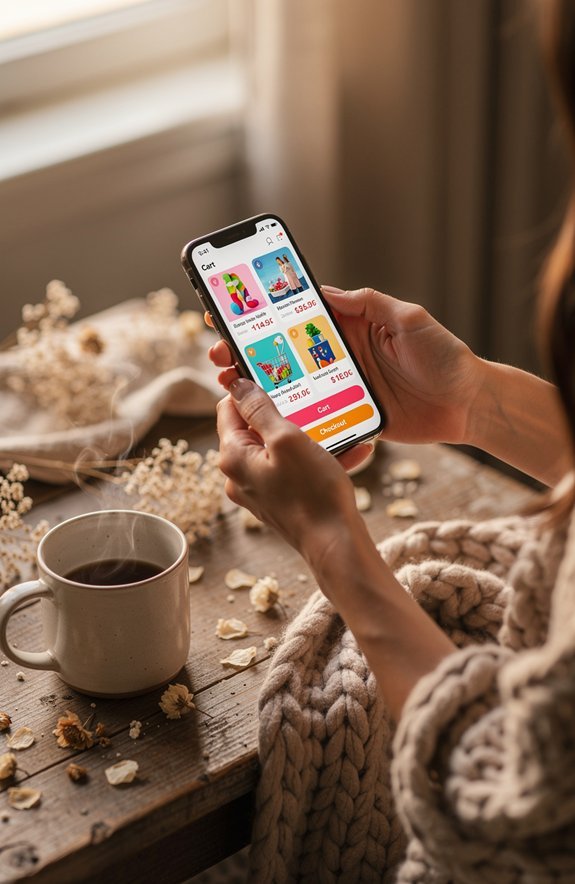
So what actually works when your thumb’s hovering over “add to cart” and your brain’s already flooding with that pre-purchase high?
I’ve found something ridiculous in its simplicity: screenshot it, then close the tab. This capture ritual genuinely tricks your reward system. You’re not denying yourself—you’re creating a screen memento, a little artifact of want without the credit card damage.
It sounds too easy, but here’s what I’ve noticed: the dopamine hit comes from claiming something, marking it as yours. A screenshot does exactly that without the buyer’s remorse hangover. You preserve the moment, that spark of discovery, without the clutter. Most of those screenshots? You’ll forget them within days, which tells you everything about whether you actually needed them. Research shows that implementing a 24–48 hour pause before non-essential purchases can reduce impulse spending by up to 30%.
Create a “Maybe Later” Wishlist That Actually Serves You

Funneling every “maybe” item into a dedicated wishlist sounds organizational, practical even.
But here’s the truth I’d to admit: most wishlists become digital hoarding spaces, guilt repositories where things go to rot while you pretend you’re being responsible.
What actually changed things for me:
- Priority Labels that force honesty—”genuine need,” “social pressure,” or “dopamine bait”
- Monthly purges where I delete anything I haven’t thought about in thirty days
- An Accountability Buddy who reviews my list with me, asking “why this, why now?”
The wishlist isn’t about postponing purchases forever.
It’s about recalibrating desire, letting FOMO exhaust itself naturally. Most items lose their emotional charge within weeks, revealing what truly matters versus what just felt urgent in that manufactured moment.
Tracking the emotional triggers behind each entry—whether it’s stress, boredom, or celebration—exposes patterns that help you recognize what’s driving the urge before it drives your wallet.
The Ten-Item Rule: Why Adding More to Your Cart Can Stop You From Buying

Although it sounds backwards, I discovered that permission to add *everything* to my cart paradoxically killed my urgency to check out.
When I let myself save every tempting thing, something weird happened—cart saturation became my friend instead of my enemy.
The dopamine hit I craved? It came from clicking “add,” not “purchase.”
The real rush was the add-to-cart button itself—buying was just the letdown that followed.
I’d pile in seventeen items, then walk away.
Returning later, I’d face choice dilution: which thing actually mattered when they all competed for attention? Usually none did.
The abundance created decision fatigue that worked in my favor, draining the emotional charge from each item.
That scarcity panic dissolved when I realized I could keep things waiting indefinitely.
Nothing was going anywhere, and neither was my money.
By inserting a pause between the impulse and the transaction, I transformed what felt like an automatic reaction into a deliberate choice I rarely made.
Redirect the Energy: Alternative Actions That Scratch the Same Itch

When I figured out that impulse buying wasn’t actually about the *thing*, I’d to face an uncomfortable truth: I was hunting for a feeling, not a product.
That dopamine hit I craved? It’s available elsewhere, without the buyer’s remorse.
I started redirecting that restless energy into actions that actually filled me up:
- Gratitude journaling for five minutes when the urge struck—writing down what I already owned that brought me joy
- Physical activity like a quick walk or stretching to burn off that antsy, must-do-something-now feeling
- Texting a friend about literally anything besides shopping
These weren’t distractions. They were substitutions that scratched the same itch without leaving my bank account bleeding.
Research shows that brief movement and social connection can actually lower cortisol levels and reduce cravings to spend.
The Price-Per-Use Calculator That Makes Decision-Making Automatic

But even when I redirected the energy, I still faced real decisions about things I actually needed.
That’s when I started calculating price-per-use, and honestly, it changed everything.
I’d divide the cost by realistic wears or uses over time amortization—suddenly that $80 jacket needed thirty wears to hit $2.67 each, which felt reasonable.
Breaking down that jacket’s cost per wear turned an impulse buy into a calculated investment I could actually justify.
That trendy lamp at fifteen uses? Nearly $5 per mood lighting session.
I also factored in resale value, because some purchases hold worth while others become donation boxes.
This wasn’t about denying myself, it was about seeing clearly.
The math removed emotion from the equation, turned want into data.
I could decide without that desperate, panicky feeling of missing out or making mistakes.
Lower cost-per-use became my signal for stronger ROI, whether I was buying boots or bar stools.
Set Up a “Cooling Off” Fund That Rewards the Pause
My system looked like this:
- Screenshot the item and its price
- Transfer that amount immediately to my cooling-off fund
- Revisit after 30 days—keep the savings or make the purchase
Some friends started a Community Pot where we’d all contribute our non-purchases and use the pooled money for group experiences.
Watching that balance grow gave me the same dopamine hit as clicking “buy,” except this time the reward came from what I’d reconsidered, not what I’d accumulated.
The key was setting friction points that didn’t rely on willpower alone—I deleted my saved payment cards from shopping apps so every purchase required me to manually enter my details, giving me time to pause.
The Permission Paradox: How Allowing Yourself to Buy Later Reduces the Urge

The cooling-off fund worked because it gave me something concrete to do with my restlessness, but I noticed something unexpected happening around day fifteen of most waiting periods. The urge would just… evaporate.
Here’s what I figured out: telling myself “not now, maybe later” felt entirely different from “absolutely never.” This Temporal Reframing removed the scarcity panic that usually hijacked my brain.
I started creating Permission Rituals—literally scheduling a calendar reminder to reconsider purchases after thirty days. The twist? By the time that notification appeared, I’d usually forgotten what I even wanted.
Turns out, dopamine fatigue is real. Giving yourself permission to want something later paradoxically makes you want it less now, because you’ve stripped away the forbidden-fruit urgency that makes impulse buying feel so irresistible.
This happens because the emotional brain drives immediate desire, but given enough time, your rational processing catches up and evaluates whether the purchase actually fits your budget and goals.
Create Friction in Your Checkout Process (Without Making It Impossible)

When I finally admitted that my browser’s autofill feature was basically a fast-pass lane to financial regret, I started dismantling the infrastructure I’d built for speed.
Removing saved payment methods felt like self-sabotage at first, but that’s exactly the point.
You want friction, not impossibility.
Here’s what actually worked:
- Delete saved cards from every app and browser—typing sixteen digits creates an Intent Check moment
- Choose slower Shipping Delay options deliberately (free seven-day shipping becomes thinking time)
- Log out after every session so re-entering passwords triggers reconsideration
The inconvenience isn’t punishment.
It’s protection from your own dopamine-seeking autopilot, creating space between wanting and having.
You’re not making buying impossible—you’re making mindless buying harder.
Behavioral researchers call this breaking the cue–craving–purchase loop, and it works because real control comes from redesigning your environment, not relying on willpower alone.
The Post-Purchase Visualization: Fast-Forward to Next Week’s Feelings

Before clicking “complete order,” I started asking myself one uncomfortable question: how will I feel about this next Tuesday? Not in the dopamine-soaked moment of checkout, but on some random weekday when the package arrives and I’m already stressed about something else.
You may also like:




This is Regret Forecasting, and honestly, it’s uncomfortable because I usually know the answer. That sweater will probably join seventeen others. That gadget will collect dust by Thursday.
Satisfaction Projection works the same way in reverse—imagining the relief of *not* buying, of waking up Wednesday with money still in my account, of not explaining another package to myself. The future version of you is usually more honest than the one holding your phone right now.
Research shows we consistently overestimate the happiness a purchase will bring while underestimating the regret, a bias known as affective forecasting that makes our in-the-moment predictions notoriously unreliable.
In case you were wondering
How Does FOMO From Social Media Specifically Trigger My Impulse Buying Behavior?
Social media floods you with peer validation signals and scarcity cues—limited-time offers, friends’ purchases, influencer endorsements—triggering FOMO stress. Your brain seeks relief through spontaneous buying, chasing emotional equilibrium and dopamine-driven instant gratification.
Are Certain Personality Types More Vulnerable to Impulse Purchases Than Others?
Yes. If you’re high in sensation seeking or low conscientiousness, you’re more vulnerable. Someone who craves novelty might impulsively grab trending gadgets, while disorganized shoppers struggle resisting spontaneous checkout temptations.
What Percentage of Impulse Purchases Do People Actually Regret Afterward?
Regret rates vary significantly: 48% of women and 54% of men never regret impulse buys. However, timeframe differences matter—you’re more likely to feel regret once excitement fades and you’ve assessed the purchase’s actual value.
Does Impulse Buying Differ Significantly Between Online and In-Store Shopping?
Online and in-store impulse buying diverge like different currents. You’ll encounter tangible sensory cues in physical stores, while online shopping reduces checkout friction—making digital purchases faster and easier to complete impulsively.
Can Therapy or Counseling Help With Chronic Impulse Buying Habits?
Yes, therapy can effectively address chronic impulse buying by teaching you cognitive strategies to manage emotional triggers and helping you establish financial boundaries. Professional counseling targets underlying anxiety, depression, or low self-esteem driving your purchases.
Conclusion
Like Odysseus tying himself to the mast, you’re not fighting the sirens—you’re just creating distance between their song and your credit card. I’ve realized the trick isn’t becoming someone who doesn’t want things. It’s becoming someone who wants the right things more. The pause isn’t deprivation, it’s recalibration. And honestly? Future you, standing in that less-cluttered closet, will feel the difference.