15 Habits That Help Me Disconnect After Work
Disconnecting after work starts with simple physical cues—close your laptop with intention, change out of your work clothes immediately (yes, even if it’s just swapping one hoodie for another), and designate a workspace you can actually leave behind. Set “Do Not Disturb” hours on all devices, take a short transition walk to clear your head, and replace doom-scrolling with analog hobbies that keep your hands busy. There’s way more to creating bulletproof boundaries that actually stick.
Key Takeaways
- Designate a specific workspace and physically close your laptop, storing it away to create clear separation between work and personal time.
- Set device boundaries by scheduling “Do Not Disturb” hours, using a separate work phone, and communicating your availability to colleagues.
- Take a transition walk after work, practice 10-minute meditation, or engage in mindful cooking to mentally reset from work mode.
- Change out of work clothes immediately and replace screen time with analog hobbies like knitting, woodworking, or playing instruments.
- Establish a consistent bedtime routine with calming activities, avoid checking emails before sleep, and keep a journal for work thoughts.
Creating a Physical “End of Day” Ritual That Signals Work Is Over

When your laptop lives on your kitchen table—or worse, your actual lap while you’re half-watching Netflix—your brain never really gets the memo that work is done.
You need physical cues that scream “I’m officially off the clock!”
Close your laptop with intention (maybe even say “goodbye” to it—no judgment).
Put it in a drawer, a bag, anywhere that isn’t staring at you.
Change into different clothes, even if it’s just swapping your “work hoodie” for your “freedom hoodie.”
These daily rituals might feel silly at first, but they’re training your brain to shift gears.
Think of it like a mental handshake with yourself: work you is clocking out, real you is clocking in.
Your nervous system will thank you.
These small transitions help establish the blurred boundaries that often contribute to burnout when left unchecked.
Changing Out of Work Clothes Immediately When I Get Home
As soon as your front door clicks shut behind you, those work clothes need to come off—like, immediately.
Don’t pass go, don’t check the mail, don’t even peek at your phone—just head straight to your bedroom and swap that work wardrobe for something gloriously comfortable.
Because here’s the thing: your brain associates those clothes with deadlines, meetings, and that one coworker who microwaves fish (we all have one).
Your work clothes are basically wearable stress triggers—ditch them ASAP and watch your brain finally exhale.
The moment you slip into your comfort clothing—whether that’s ancient sweatpants, pajamas, or that hoodie with the mysterious stain you refuse to throw away—you’re sending your mind a powerful message.
Work mode? Over.
Relaxation mode? Activated.
It’s like Clark Kent ditching the suit, except your superpower is finally being able to breathe without restrictive waistbands.
This simple clothing swap acts as a predictable cue that signals safety to your nervous system, helping you transition from work stress to genuine relaxation.
Setting Strict “Do Not Disturb” Hours on All Devices

You’ve changed clothes—nice work! Now let’s tackle those buzzing, pinging, attention-stealing devices that keep pulling you back into work mode.
Here’s the thing: device management isn’t just helpful—it’s essential for boundary enforcement. Schedule “Do Not Disturb” from 6 PM to 8 AM (or whatever works for you), and yes, that includes your laptop, phone, and tablet. All of them.
Your boss’s “quick question” at 9 PM? It can wait.
That Slack notification? Also waitable.
I know it feels weird at first—like you’re being irresponsible or something. But here’s the truth: if it’s truly urgent, they’ll call twice.
Everything else is tomorrow’s problem, and protecting your evening sanity is today’s priority.
Constant phone checking is actually a hurry habit that keeps your nervous system activated even when you’re technically off the clock.
Your future self will thank you.
Designating a Physical Workspace That I Can Leave Behind
If your “office” is currently your couch, your kitchen table, and sometimes your bed—well, we need to talk about boundaries.
Here’s the thing: when work lives everywhere, you can never really leave it behind. Your brain doesn’t know when to switch off because there’s no physical separation between “work mode” and “rest mode.”
You don’t need a fancy home office (though that’d be nice). Even a specific corner with a dedicated desk works wonders for workspace organization.
The magic happens when you can literally walk away at day’s end.
Close the laptop. Leave that space. Done.
Your bedroom stays a bedroom. Your couch remains a couch—not a conference room.
This simple boundary tells your brain: work stays there, life happens here.
When clutter removal exposes habits, you’ll notice how your workspace setup either supports or sabotages your ability to mentally disconnect.
Taking a Transition Walk to Clear My Mind

Walking away from your workspace is great, but sometimes your brain forgets to leave with you.
That’s where a transition walk works magic—it literally moves work stress out of your body.
A transition walk physically shifts work stress from your mind into movement—your body’s reset button in action.
Even ten minutes helps. You don’t need fancy gear or a destination (your neighborhood works perfectly). The key is mindful walking, where you notice what’s actually around you instead of replaying that awkward Zoom call.
Try this: spot five things you’ve never noticed before on your usual route. A quirky mailbox, interesting tree bark, that one house with the bold paint choice—nature appreciation doesn’t require mountains and sunsets.
Your body learns the pattern quickly. Walk equals done with work.
It’s basically teaching your brain: we don’t solve spreadsheet problems during bird-watching time.
These short breaks actually reduce cortisol levels while improving your ability to focus when you return to work the next day.
Deleting Work Email and Slack Apps From My Personal Phone
While everyone else debates work-life balance in theory, here’s something concrete you can do in about thirty seconds: delete those work apps from your phone.
I know, I know—it feels dramatic at first. What if there’s an emergency? (There won’t be.) What if your boss needs you? (They’ll call.)
But here’s the thing: having Slack and email on your personal phone turns every grocery store run, every dinner, every Sunday morning into potential work time.
It’s like carrying your office in your pocket.
This simple digital detox changed everything for me. Without those little red notification dots tempting me, I actually relax during my free time—and shockingly, work hasn’t collapsed.
Your brain treats this constant availability as cognitive overload, making it nearly impossible to shift out of work mode even when you’re technically off the clock.
Your evenings belong to you.
Delete the apps.
Scheduling Non-Negotiable Evening Activities That Demand My Presence

The best way to stop working late is to make it physically impossible—and that means putting something else on your calendar that you absolutely can’t miss.
I’m talking about evening commitments that force you to log off: a 7 PM yoga class, dinner with friends, your kid’s soccer practice, even a standing Tuesday night phone call with your mom.
These social engagements become your escape hatch.
When you’ve got somewhere to be, you can’t rationalize “just one more email” (which always turns into twelve).
Your brain shifts from “I should probably wrap up” to “I need to leave in ten minutes”—and suddenly you’re closing your laptop instead of doom-scrolling Slack.
It works because accountability matters.
Treat these commitments as important appointments that deserve the same respect you’d give a client meeting—because reclaiming your evening is just as critical as any work deadline.
Using a Separate Work Phone That Gets Turned Off at 6 PM
Beyond scheduling commitments that pull you away from your desk, you need a hard line between work and home—and nothing draws that line faster than a separate work phone that literally powers down at quitting time.
Here’s the thing: when your boss can text you at 9 PM, they will. It’s not personal—it’s just how work expands to fill every available space in your life.
A dedicated work phone changes everything.
At 6 PM, you power it down. Done. No “just checking one thing” at dinner, no midnight email spirals.
Phone boundaries like this transform your work life balance from wishful thinking into actual reality. You’re physically unable to respond after hours (oops, phone’s off!), which trains everyone—including yourself—that evenings are sacred.
When you’re constantly available, your nervous system remains in threat mode, never fully relaxing and always preparing for the next work demand.
It’s honestly liberating.
Practicing a 10-Minute Meditation to Reset My Mental State

After your work phone powers down, your brain still hums with meeting replays and unfinished task lists—which is exactly why you need a hard mental reset before jumping into evening mode.
That’s where ten minutes of meditation swoops in like a superhero.
You don’t need fancy apps or perfect posture (though sitting helps more than face-planting into your couch). Just find a quiet spot, close your eyes, and focus on breathing—in through your nose, out through your mouth, repeat until your thoughts stop screaming about spreadsheets.
These simple mindfulness techniques work wonders for stress relief. They create an actual boundary between Work You and Home You.
Mindfulness builds a mental wall between your work brain and home brain—giving each version of you the space it deserves.
Will your mind wander? Absolutely.
That’s normal. Gently redirect it back to breathing each time.
Consider it like training a puppy—patience required, results guaranteed.
As you settle into the practice, naming whatever distracting thoughts arise—”worrying,” “planning,” “replaying”—can help reduce physiological stress responses and quiet your nervous system even faster.
Cooking Dinner as a Mindful Activity That Requires Full Attention
Once your mind settles from meditation, your stomach probably starts sending pretty loud signals about dinner—and here’s the beautiful part: cooking can become your second reset of the evening.
When you’re chopping vegetables or stirring a pan, your hands are busy and your brain can’t wander back to work emails (it’s literally impossible to dice an onion while obsessing over that afternoon meeting).
This is where mindful ingredients make all the difference—focusing on textures, colors, and smells pulls you completely into the present moment.
Think of it as culinary creativity meets therapy.
You’re not just making food; you’re engaging all five senses in something tangible and rewarding.
Plus, you get to eat your masterpiece afterward, which meditation definitely doesn’t offer.
The organized ritual of cooking—with clear counters and everything in its place—helps lower cortisol levels and signals to your nervous system that the workday is truly over.
Establishing a “Brain Dump” Journal to Park Work Thoughts

Right before bed—or honestly, the second you walk through your door—your brain becomes this annoying filing cabinet that won’t shut, constantly flipping through unfinished tasks and tomorrow’s to-do list like some obsessive librarian.
That’s where a brain dump journal saves your sanity.
Just grab any notebook (fancy or dollar-store, doesn’t matter) and write down every work thought rattling around.
Don’t organize it, don’t make it pretty—just let it spill out onto the page like you’re emptying a cluttered junk drawer.
The act of physically writing it down tricks your brain into thinking, “Cool, it’s documented, we can stop obsessing now.”
You’ll feel this instant mental clarity, like someone finally turned down the volume on all those work-related thoughts competing for your attention.
Communicating My Boundaries Clearly With Colleagues and Managers
Look, nobody’s going to respect your work-life boundaries if you don’t actually tell them those boundaries exist—colleagues aren’t mind readers, and your manager definitely isn’t going to assume you don’t want Slack messages at 10 PM.
Boundary setting requires clear communication. Here’s how to make it happen:
- Set your availability hours explicitly. Tell your team, “I’m available 9-5, but I disconnect after that unless there’s a genuine emergency.”
- Update your email signature and Slack status. Add something like, “I respond to messages during business hours—if it’s urgent, call me.”
- Actually stick to what you’ve said. Don’t answer emails at midnight (you’re training them that boundaries don’t matter).
It feels awkward initially, but most people respect honesty way more than passive-aggressive silence.
Replacing Screen Time With Analog Hobbies That Engage My Hands

After you’ve set your boundaries and logged off, the hardest part isn’t actually stopping work—it’s stopping the urge to immediately grab your phone and scroll through something else.
Here’s what actually works: pick up something that keeps your hands busy. Knitting or crocheting transforms your fidgety energy into something tangible—like a scarf that proves you’re productive without staring at another screen.
Building model kits demands focus that crowds out work thoughts.
Try exploring outdoor activities, gardening for relaxation, or woodworking for fun. Maybe painting or drawing, practicing musical instruments, or crafting DIY projects speaks to you.
Even learning new recipes counts (bonus: you get to eat your creation).
The trick is engaging in creative writing or anything that makes checking your phone physically inconvenient.
Your brain needs actual rest, not just different content.
Setting an Automatic Email Response for After-Hours Messages
Even when you’ve physically stepped away from your desk, people can still find you—and they will, usually right when you’re finally relaxing.
Setting up an automatic email response creates after hours boundaries without the awkwardness of ignoring messages (or the guilt that comes with it).
Auto-replies let you set boundaries without guilt—protecting your time while keeping communication professional.
Here’s what makes a good auto-reply work:
- Be direct about availability — “I’m offline until 9am tomorrow and will respond then”
- Skip the apologies — you’re allowed to have boundaries, seriously
- Offer alternatives for emergencies — list a backup contact if needed
This simple email etiquette move trains people when to expect responses.
It’s not rude—it’s professional self-care.
And honestly? Most “urgent” emails can wait until morning anyway.
Creating a Consistent Bedtime Routine That Prioritizes Sleep
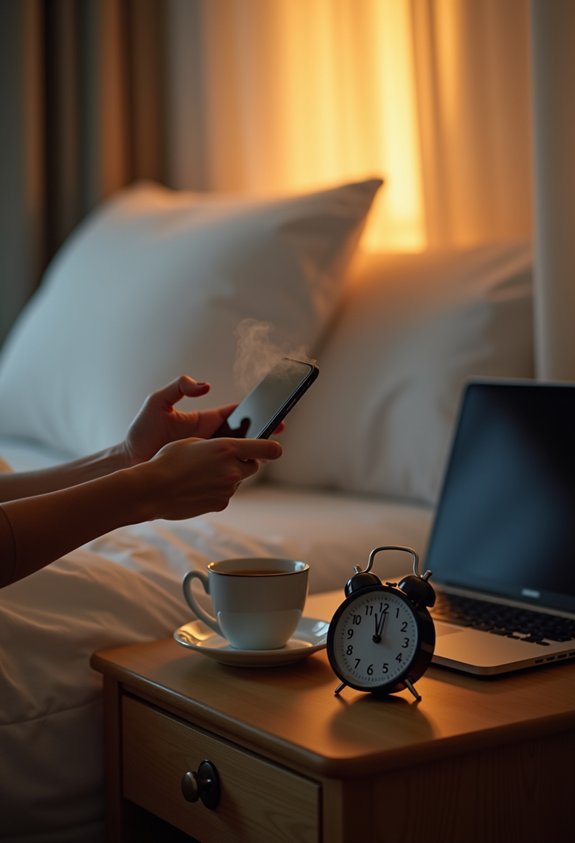
Your brain doesn’t just flip off like a light switch—it needs time to wind down, which is why scrolling through work emails at 11pm leaves you staring at the ceiling at 2am replaying that awkward Zoom call.
Good sleep hygiene means creating a routine that tells your body, “Hey, we’re done now.”
Try this: set a specific time to start winding down—same time every night. Bedtime consistency trains your brain like Pavlov’s dog, except the reward is actually sleeping instead of panicking about tomorrow’s meeting.
You may also like:




Thirty minutes before bed, ditch the screens. Read something mindless (celebrity memoirs, anyone?), take a warm shower, or do some gentle stretches.
Your body craves predictability. Give it that, and you’ll actually disconnect.
Instead of doom-scrolling, you’ll be dream-scrolling.
In case you were wondering
What if My Job Requires Me to Be Available for Emergencies?
You’ll need work life integration rather than complete disconnection. Set clear emergency protocols with your team—define what constitutes a true emergency, establish response timeframes, and create boundaries for non-urgent matters. This protects your personal time while remaining accessible.
How Do I Disconnect When I Work From Home Full-Time?
Create physical boundaries by designating a specific workspace you’ll leave at day’s end. Schedule regular digital detox periods where you’re completely offline. Establish rituals that signal work’s over, helping you maintain healthy work life balance despite remote work.
What if My Boss Doesn’t Respect My Boundaries?
You’ll need clear boss communication about your availability and direct boundary setting conversations. Document your work hours, have a firm discussion about expectations, and if they continue disrespecting boundaries, consider whether this job’s sustainable long-term.
How Long Does It Take to Form These Disconnection Habits?
Like planting a garden, you’ll need patience. Habit formation typically requires 2-3 months of consistent practice. Your time investment varies by complexity, but most disconnection routines stick within 66 days if you’re persistent and intentional daily.
Can I Still Check Work Messages Occasionally in the Evening?
You can check occasionally, but set specific boundaries to protect your work life balance. Designate one brief check-in time rather than continuous monitoring, preserving your evening productivity for personal activities and genuine relaxation you need.
Conclusion
Disconnecting from work is like turning off a light switch—it takes practice, but eventually it becomes automatic. You’re building new habits, and that’s hard work in itself. Some days you’ll nail it, other days you’ll catch yourself checking emails at 9 PM (we’ve all been there). But here’s the thing: every small boundary you set matters. You’re teaching yourself—and everyone around you—that your time off is sacred.