How to Simplify Your Life Without Missing Out
You simplify your life by saying no to the *noise*—not the good stuff. Skip guilt invites, extra group chats, and “limited-time” everything, then use that time for sleep, walks, hobbies, and real friends. Tidy one drawer, unsubscribe from junk email, delete three apps, and track your money in one simple list, so your brain isn’t constantly buzzing. You’re not missing out—you’re trading chaos for calm, and there’s a very doable way to start.
What you will leave with
- Redefine “missing out” as choosing rest, sanity, and alignment with your values over social pressure and fear of scarcity.
- Build resilience with consistent movement, sleep, and tiny grounding rituals so a simpler schedule still feels rich, not empty.
- Cut digital noise by deleting nonessential apps, unsubscribing from junk, and using screens only with a clear, time-limited purpose.
- Simplify your home one small area at a time, keeping only what supports your future self and makes daily life smoother.
- Streamline money with a basic plan: track cash flow, avoid fees, and slowly build a small emergency buffer for peace of mind.
Redefining What “Missing Out” Really Means

Ever notice how “missing out” now feels like a crime against fun, instead of… just staying home in sweatpants?
Missing out isn’t a failure; sometimes it’s just choosing sweatpants and sanity over noise
You see a party online, a “can’t miss” sale, a trip you’re not on, and your brain screams, “Everyone’s there but me!”
But that panic comes from loss aversion and scarcity thinking—your mind acts like every invite is the last raft off a sinking ship, even when it’s just trivia night at a loud bar.
Try reframing experiences: instead of “I’m losing something,” ask, “What am I gaining by saying no?”
Maybe it’s sleep, real rest, or embracing solitude—reading in bed, doing a face mask, or finally watching that cheesy movie alone, without pretending you love crowded rooftops at midnight.
By choosing fewer obligations and less clutter in your schedule and space, you lighten your cognitive load, making it easier for your nervous system to relax and actually enjoy what you keep.
Building a Body and Mind That Can Handle Less

Some days it feels like life expects you to be a Navy SEAL with an iPhone—handling work, drama, news, and ten group chats without breaking.
So you build physical resilience on purpose—walk most days, do simple strength moves, maybe yoga or stretching, and let your nervous system learn, “Hard things are okay, I can handle this,” instead of, “Panic, everything’s on fire.”
Mindfulness ties the mind body connection together—slow breathing, quick body scans, or a two‑minute “feel my feet on the floor” reset, plus kind self‑talk when you mess up, lowers the mental noise and stops the all‑or‑nothing spiral. Adding tiny, predictable rituals like a morning stretch or evening tea creates cues of safety that quietly train your nervous system to stay grounded even when life gets loud.
Sleep, real food, water, tiny joys (music, drawing, bad dancing in the kitchen)—they’re not extras, they’re your daily armor.
Clearing the Digital Noise Without Disconnecting From Life

How did your phone turn into that noisy friend who never stops talking—even when you’re just trying to breathe? You’re not broken, the digital world is just loud, and it piles up fast—photos, files, apps, emails, all shouting for attention. Start with simple digital decluttering techniques: list your devices and accounts, then delete one useless app row, one old folder, one “why did I save this?” screenshot at a time. Next, practice mindful technology usage—decide what your tech is for (connection, work, fun), then let the rest go. Unsubscribe from junk emails, close dead accounts, and move key files to one cloud service so everything’s safer, lighter, and way less noisy. Treat your screen time like a taming digital overload experiment by setting gentle boundaries—specific check-in times, fewer notifications, and short timers—to keep your mind clearer without going offline.
Lightening Your Home So It Actually Works for You
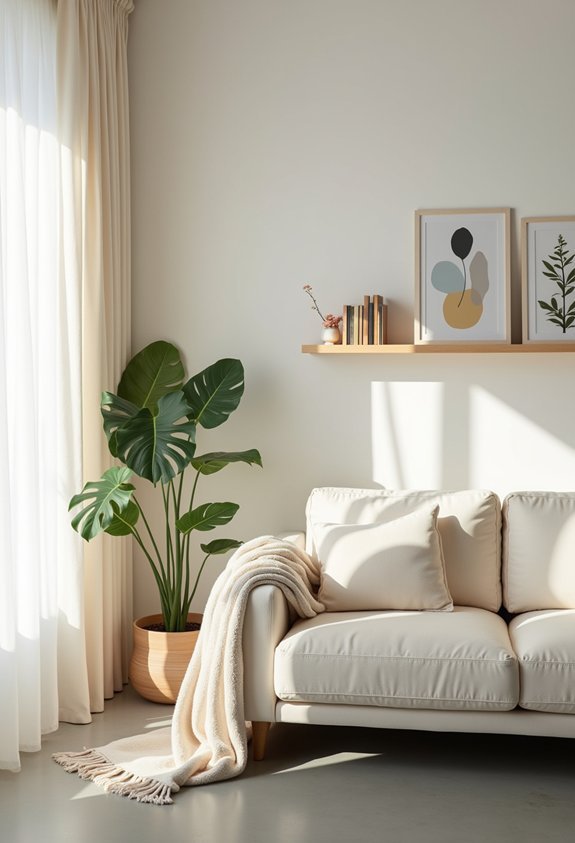
Your phone isn’t the only thing yelling for attention—your home’s probably talking too, through piles, mess, and “I’ll deal with it later” corners. You feel it every time you can’t find scissors, or a clean pan, or your sanity. Start small. One drawer, one shelf, one “doom box” that’s been haunting you for months, then toss what you don’t use, love, or even remember buying. When you’re sorting, think about whether each item genuinely supports your future self instead of keeping it out of guilt or habit. Think “clutter free living,” not “Pinterest museum”—your space should work for real life, not a photo shoot. Use efficient storage you’ll actually maintain: clear bins, drawer dividers, hooks by the door, a basket on the stairs. Create tiny zones—coffee, mail, kids’ stuff—so everything has a simple, obvious home. Even for future-tired-you.
Making Money Simple Enough to Support What Matters

Ever feel like money is this loud, confusing group chat you never meant to join—but it just keeps pinging anyway?
You’re not alone—most people never learned basic financial literacy, then blame themselves when things feel messy and scary.
So start simple.
Pick one small goal this month—like “no overdraft fees”—and track just three things: income, bills, and what’s left for life.
Then build a tiny emergency savings buffer, even $10 a week, so a flat tire or vet bill doesn’t wreck everything and send you into panic-scroll mode.
Next, sketch a 10-minute plan on paper—rent, food, minimum debt, fun—so you see where your money actually goes, and can slowly shift it toward what matters most to you.
Over time, that simple clarity helps you raise your savings rate, trust long-term compounding, and build a calm, predictable path toward real financial freedom.
Trimming Your Calendar While Keeping Key Connections

Then fix meeting efficiency: shorten recurring meetings, combine two small ones into one, and cancel anything without a clear goal.
Batch calls on certain days, protect a few big focus blocks, and leave white space—because open time isn’t wasted time, it’s breathing room.
Use this freed-up time to regularly audit where your time goes so your calendar actually reflects what matters most to you.
Staying Simple for the Long Haul in a Busy World

Think of mindful minimalism as “only what truly matters”—in your body, your plate, your people, your sleep. You move most days (walks, dancing in the kitchen, chasing the dog), you eat mostly real food, and you protect bedtime like it’s a VIP party for your pillow. Over time, you start to value space as breathing room more than stuff, letting your environment support the kind of calm, intentional life you actually want.
Intentional living also means you don’t do health alone. You join a walking group, a pickleball meetup, or an online book club—anything that keeps you laughing, moving, and showing up.
And stress? You treat it like spam email—notice it, label it, then delete what you can, with deep breaths and small, daily resets.
You may also like:





In case you were wondering
How Do I Get Family on Board With Simplifying When They Resist Change?
Start by listening to fears, then co-create small, low‑risk changes. Use positive framing, concrete benefits, and examples. Involve everyone’s choices, pace, and feedback. These family engagement and resistance strategies turn “your plan” into “our experiment.”
Can Simplifying Help With Anxiety or Burnout From Work and Caregiving?
Yes—simplifying can slice mountains of anxiety into pebbles. You trim obligations, protect rest, and build small mindful practices that turbo‑charge stress reduction, ease burnout from work and caregiving, and help you feel steadier, clearer, and more present.
What if My Culture Equates Success With Owning More and Staying Busy?
You can quietly redefine success definitions, even when cultural perceptions equate worth with owning more and staying busy. You choose different metrics—health, relationships, integrity—while still meeting essentials, setting boundaries, and resisting pressure to perform nonstop.
How Can I Simplify Life When Living With Roommates or in Shared Housing?
You simplify life in shared housing by treating shared spaces like a garden: set clear boundaries, post simple house rules, use decluttering strategies, respect privacy, share costs transparently, meet regularly, and schedule quiet hours and communal time.
Is It Possible to Simplify With Kids Who Constantly Bring in New Clutter?
Yes, you can simplify. Focus on clutter management by limiting what comes in, rotating toys, and creating donation rituals. Prioritize kids’ involvement: let them sort, choose favorites, and celebrate “letting go” to protect space and calm.
Conclusion
In a study, people who chose fewer daily tasks felt calmer—kind of like closing 20 tabs on your brain.
You can do that too, one small choice at a time—one drawer cleaned, one app deleted, one “nope” to a draining plan, one “yes” to a slow walk.
You’re not falling behind.
You’re just stepping out of the stampede—so you can actually enjoy the view.