The Decluttering Framework for Indecisive People
Your home can feel like a quiet argument between what you use and what you’re afraid to decide about. When you struggle to choose, clutter piles up and every object starts to feel loaded with pressure. Instead of forcing big, painful decisions, you’ll set simple rules, test items with low-risk experiments, and rely on a clear workflow. You’ll still keep what matters—but the way you decide what stays is about to change.
Understanding Why Decisions Feel So Hard

When every item feels important or “potentially useful,” each choice to keep or discard forces your brain into a mini tug-of-war. You’re not lazy or messy; you’re overloaded.
First, understand that every micro-choice drains mental energy, creating decision fatigue. Your brain keeps scanning for the “perfect” answer, so you stall.
Each tiny keep-or-toss decision drains mental energy, feeding decision fatigue and endless, perfectionist second-guessing
Second, notice how emotional attachment complicates things. Objects may hold memories, identity, or security, so letting go feels risky, not trivial.
Third, recognize your fear of regret: you imagine needing the item later and blame yourself in advance.
To move forward, start labeling what’s really happening: “This is fatigue, not failure,” or “This is attachment, not actual usefulness.” Naming the pattern reduces anxiety and restores your ability to choose. That clarity makes decisions simpler.
Setting Gentle Boundaries for What Stays and Goes
Now that you can see why every choice feels loaded, you’ll make progress by setting clear, gentle rules for what stays and what goes.
Begin by naming your intention: more space, easier cleaning, or calmer mornings.
Then practice mindful reflection with each item. Ask, “What role does this play in my life right now?” Notice emotional attachment without judging it. You’re not forcing yourself to purge; you’re defining a safe zone for what truly supports you.
Create three mental buckets: definitely keep, maybe, and ready to release. Place items accordingly, then move on without rethinking.
If you feel stuck, pause, breathe, and revisit your intention. Boundaries guide you so each decision feels contained, not overwhelming.
Over time, this consistency rebuilds trust in your judgment.
Creating Simple Rules That Make Choices Automatic
Instead of debating every single item, you can create simple rules that make most choices for you.
Start by translating your boundaries into if-then statements: “If I haven’t used it in a year, I donate it,” or “If it doesn’t fit my current lifestyle, it goes.”
These rules reduce decision fatigue by turning each object into a quick yes/no.
Post your rules on a note in the room you’re working in.
Apply them item by item, without re-arguing each case.
When you feel stuck, add a clarifying rule rather than a new exception.
Over time, your set of rules becomes a personal system that produces automatic choices and keeps clutter from quietly rebuilding.
You stop stalling and start clearing with steady, confident momentum today.
Using Low-Stakes Experiments to Test Letting Go
Although firm rules simplify most decisions, some items still feel risky to release, which is where low-stakes experiments come in.
You treat letting go as a series of low stakes challenges instead of permanent verdicts. Pick a doubtful item and remove it from daily use for a set period, usually 30 days. Track how often you miss it and what problem actually appears. Support this with simple decision making techniques. Write your observations so your future self remembers the reality:
- Place the item in a labeled “trial separation” box with a date.
- List what the item realistically does for you today, not ideally.
- Brainstorm alternatives you already own that cover the same function.
- After the trial, decide: keep, donate, or extend the experiment briefly.
A Step-by-Step Workflow for Tackling Any Space
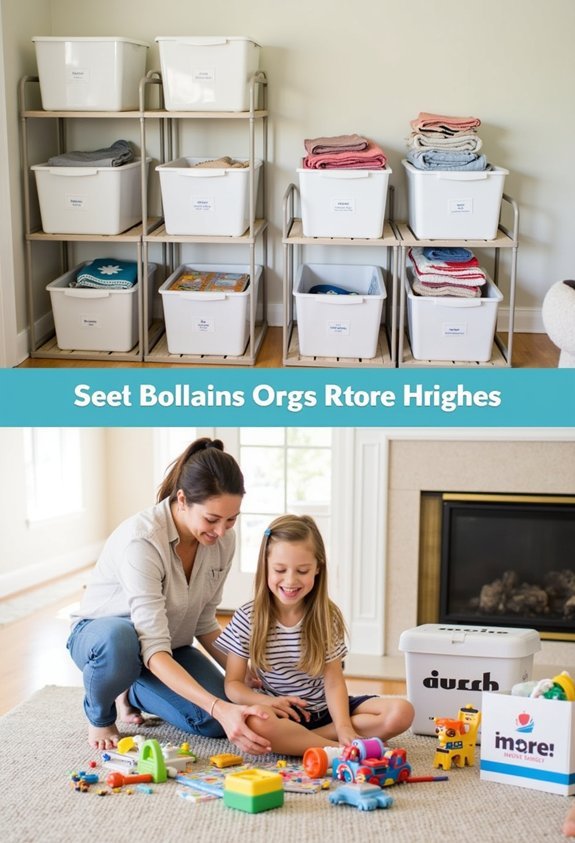
One reliable way to beat overwhelm in any room is to follow a repeatable workflow: you’ll move through the same clear steps whether you’re dealing with a junk drawer, a closet, or your entire living room.
First, define the room’s purpose in one short sentence; use it as your filter. Then do a quick sweep, removing obvious trash and relocations.
You may also like:
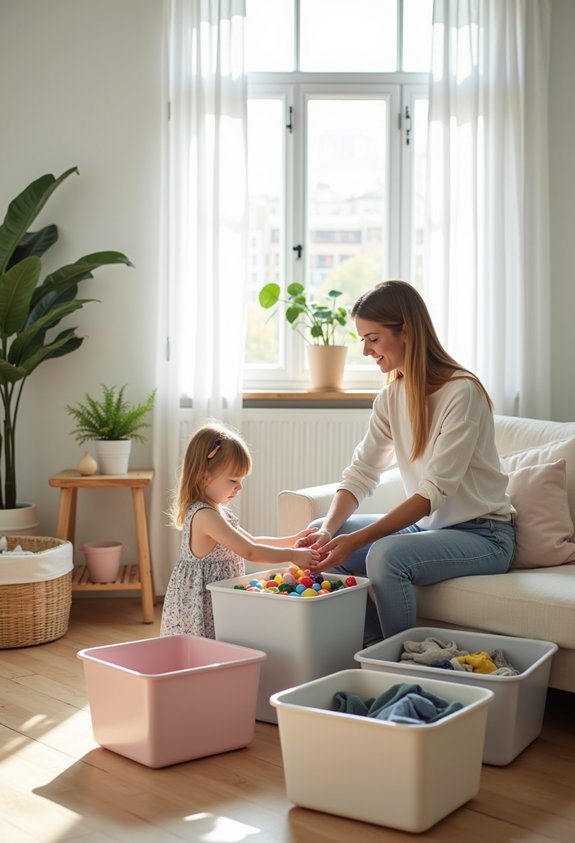
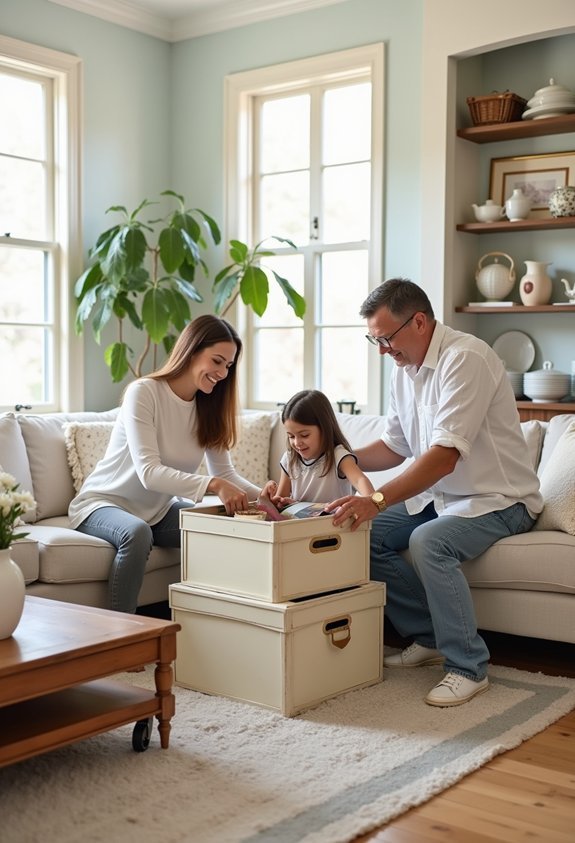

Next, empty one small zone completely so you’re visualizing space, not piles. Group similar items, then decide: keep, relocate, donate, or discard.
When stuck, notice emotional attachments and ask, “Does this support my defined purpose now?” Contain what you keep with boxes, dividers, or shelves, label quickly, then reset the zone before moving to the next.
Stop after each zone to assess and breathe.
Keeping Clutter Away With Easy, Repeatable Habits
Two simple habit categories will keep your spaces from slipping back: quick resets and automatic rules.
Quick resets are tiny, time‑boxed tidy-ups you repeat daily; automatic rules remove decisions so you act without debate.
Use mindful organization to notice where clutter reappears, then design specific micro-habits.
Apply habit stacking: attach each new action to something you already do, so the cue is built in.
- After making coffee, clear the counter and return every item to its home.
- When you bring in mail, sort it immediately into “act,” “file,” or “recycle.”
- Before bed, spend five focused minutes resetting one high-traffic surface.
- Every Sunday, walk your home with a small bin, rehoming or discarding strays.
This keeps maintenance light, consistent, and automatic.
Conclusion
As you declutter, imagine you’re the gardener of a small, overgrown plot. You’ve learned how to choose which plants stay, which move to the “maybe” bed, and which you’ll gently compost. Use your rules as tools, your experiments as test plots, and your habits as daily watering. Each pass, you’re not just clearing stuff—you’re cultivating a landscape you can actually walk through, maintain, and calmly call your own.