The Minimalist’s Guide to Raising Intentional Kids
Raising intentional kids means creating space—both physical and mental—for what truly matters. Start by involving your children in decluttering their toys, making it a joyful game rather than a guilt trip, and rotate what stays out monthly. Build simple family rituals like Saturday pancakes or tech-free evenings that prioritize connection over screens. Teach them that boredom sparks creativity and experiences beat stuff every time. When you establish these rhythms and boundaries now, you’ll discover practical strategies that transform daily chaos into meaningful moments.
Key Takeaways
- Declutter thoughtfully by involving children in sorting toys, rotating items monthly, and donating unused possessions to create calm spaces.
- Establish predictable family rhythms with simple rituals and screen-free time to prioritize meaningful connection over productivity.
- Teach children to find joy in experiences like baking and fort-building rather than accumulating material possessions.
- Set clear digital boundaries including screen time limits and monthly detox periods while modeling healthy technology habits.
- Foster mindful consumption through value conversations, wishlists, and delayed purchases to distinguish wants from needs.
Decluttering Your Child’s Physical Space Without Tears or Tantrums
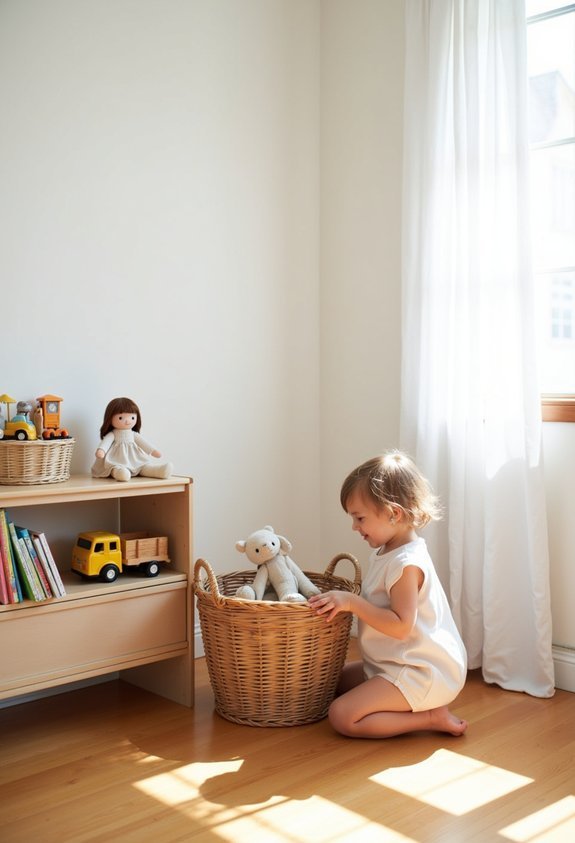
If you’ve ever stood in your child’s bedroom ankle-deep in plastic toys, mismatched puzzle pieces, and those tiny rubber bands from who-knows-what craft kit, you already know the truth—clutter isn’t just messy, it’s exhausting for everyone.
Clutter isn’t just messy—it’s exhausting for everyone, especially when you’re ankle-deep in plastic chaos and mismatched pieces.
Here’s the secret: involve your kid in mindful sorting instead of sneaking trash bags out at midnight (we’ve all been there). Make it a game—keep toys that spark genuine joy, not guilt-driven “but Grandma gave me this.”
Try toy rotation next. Box up half their stuff and swap it monthly. Suddenly, “old” toys feel new again.
And please, ditch the broken crayons.
Your child won’t melt down when they’re part of the process—they’ll feel empowered. As a general rule, if a toy hasn’t been played with weekly, it’s a candidate for donation and can help create space for movement that your family actually needs. Plus, you’ll finally see their floor again.
Creating a Family Rhythm That Prioritizes Presence Over Productivity
We’ve bought into this bizarre idea that a good childhood looks like a color-coded schedule with zero white space.
But here’s the truth—your kids don’t need another activity. They need you, unrushed and actually paying attention.
Family rituals don’t have to be Pinterest-worthy. Think simple: Saturday morning pancakes, bedtime stories that run long, or walking the dog together after dinner.
These intentional activities create connection without the pressure of performance.
Presence beats productivity every single time.
Start by blocking off one evening a week—no sports, no homework panic, just being together.
You’ll be amazed how much your kids open up when they’re not being shuttled somewhere.
Predictable family rituals stabilize your children’s nervous systems and create those vital cues of safety they need to thrive.
The goal isn’t doing more. It’s doing what matters.
Teaching Children to Find Joy Beyond Material Possessions

How did we end up in a world where kids expect a prize just for showing up to Tuesday?
Here’s the truth—you can break that cycle without feeling like the meanest parent on the block.
Start creating joyful experiences instead of opening your wallet. Bake cookies together, build blanket forts, have living room dance parties.
The best memories don’t come from a store—they come from flour on faces and forts that barely stand.
These moments stick way longer than any toy.
Point out meaningful connections when they happen. “See how happy Grandma looked when you called her?”
Let boredom exist. (Yes, really.) It’s where creativity lives.
When your kid begs for another toy, try this: “Let’s add it to your wishlist and see if you still want it next month.”
Most times? They’ll forget.
And that’s exactly the point.
Research shows that flexible family routines lead to lower stress and stronger connections—far more valuable than any material reward.
Establishing Healthy Digital Boundaries in a Hyperconnected Age
While your grandparents worried about too much TV, you’re over here negotiating with a tiny human who thinks Wi-Fi is a basic human right.
Welcome to modern parenting.
Here’s the thing—screen time isn’t evil, but unlimited access absolutely messes with developing brains (and honestly, adult ones too).
Set clear boundaries early: maybe tablets only on weekends, or phones that get parked in a kitchen basket after 7 PM.
Try a monthly digital detox together. Go outside. Build something. Get bored—yes, bored is actually good for creativity.
Just like physical clutter triggers stress responses in your nervous system, digital clutter creates the same cognitive overload for kids, making it harder for them to focus and regulate emotions.
The best part? When you model healthy tech habits yourself, your kids notice.
They see you choosing connection over scrolling.
And that matters way more than any parental control app ever could.
Nurturing Inner Values When Consumer Culture Surrounds Them
Your kid’s just mastered putting down the iPad, and now they’re asking why every friend at school has the new whatever-it-is and they don’t.
Welcome to the next level.
Here’s the thing—you can’t lock them in a consumer-proof bubble (tempting though it may be).
Instead, start value conversations early and often. When they beg for that toy everyone has, ask: “Will this matter to you next month?”
It’s not about saying no to everything. It’s about mindful consumption—teaching them to pause before wanting becomes needing.
Try this: give them a “maybe list” where desires sit for two weeks. Most items? Forgotten by Tuesday.
You may also like:



Research shows that implementing a 24-hour delay before purchases can reduce discretionary spending by 20-30%, and this same principle works wonders with children.
The goal isn’t raising kids who never want things.
It’s raising kids who know the difference between what they want and what truly matters.
In case you were wondering
How Do I Handle Pushback From Extended Family Who Give Excessive Gifts?
Have honest family communication about your gift boundaries before holidays. Suggest alternatives like experiences, savings contributions, or one meaningful gift. Thank them genuinely while firmly redirecting extras. You’re protecting your children’s values, not rejecting their love.
What Age Should I Start Introducing Minimalist Principles to My Children?
Plant seeds early—you can start toddler teachings around age two with simple choices. As kids grow, deepen conversations naturally. Teen transitions require more dialogue about values and consumerism. There’s no single perfect age; it’s an ongoing journey.
How Do Minimalist Parenting Practices Affect Children’s Social Relationships With Peers?
Minimalist parenting strengthens your child’s peer interactions by encouraging meaningful connections over material comparisons. Your kids develop stronger social skills through collaborative play and shared experiences, rather than bonding over possessions. They’ll form deeper, more authentic friendships naturally.
Can Minimalist Parenting Work in Small Living Spaces With Multiple Children?
Yes, you’ll thrive with minimalist parenting in tight quarters. Space optimization becomes essential when you’re implementing multi child strategies—shared bedrooms, rotating toys, and vertical storage maximize your area while teaching cooperation and resourcefulness among siblings.
How Do I Maintain Minimalist Values When My Co-Parent Disagrees?
Focus on your own actions and lead by example. Use effective communication techniques to explain your values without judgment. Develop co-parenting strategies that compromise—perhaps minimalism in shared spaces while respecting your partner’s personal areas and parenting choices.
Conclusion
You’ve got this—really, you do. Raising intentional kids isn’t about being perfect (thank goodness, because who has time for that?). It’s about small, consistent choices that add up over time. Will you mess up? Absolutely. Will your kids sometimes want every toy they see? Of course. But here’s the thing: you’re already doing the hard work by questioning what matters most. And that—that changes everything.