11 Ways to Simplify Your Finances Without Spreadsheets
You can ditch the spreadsheets and still crush your money goals—start by using mobile banking apps that automatically track your spending, set up round-up savings apps that stash spare change for you, or try the cash envelope method for a tangible budget you can see and feel. Automate bill payments so you never miss a due date, use visual charts to understand where your money goes at a glance, and consider splitting funds across different bank accounts for specific goals. There’s a whole toolkit of simple strategies that’ll transform how you handle your finances.
Key Takeaways
- Mobile banking apps automatically categorize purchases and provide instant spending visibility without manual tracking or complicated spreadsheets.
- Round-up savings apps automatically save spare change from purchases, averaging $30-50 monthly without requiring mental calculations or tracking.
- Cash envelope budgeting divides physical cash into labeled categories, providing immediate spending feedback without digital tracking tools.
- Visual tools like pie charts in banking apps transform spending data into simple pictures, revealing habits without complex calculations.
- Multiple bank accounts create goal-oriented savings buckets, automatically splitting paychecks to prevent accidental spending on essential expenses.
Use Mobile Banking Apps With Built-In Spending Trackers
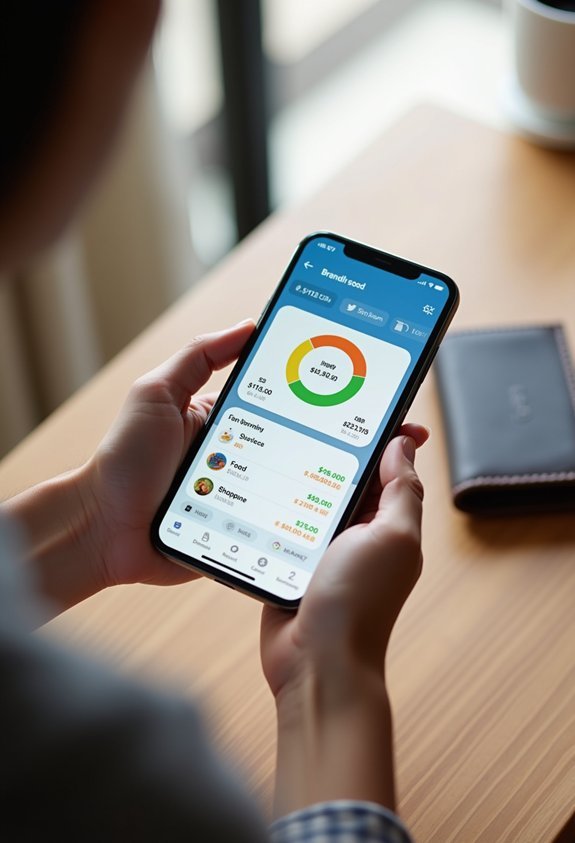
Mobile banking apps have gotten ridiculously smart lately—and honestly, it’s about time they caught up with the rest of our lives.
Here’s the deal: most banks now automatically sort your purchases into spending categories without you lifting a finger. Coffee runs? Tracked. That random Tuesday Target spree? Also tracked (no judgment—we’ve all been there).
Your spending gets automatically categorized—from coffee to impulse buys—without any effort on your part.
The best part? You can open your mobile banking app while waiting in line, see exactly where your money went this month, and make smarter decisions on the spot.
No more guessing if you’ve blown your dining-out budget or wondering why your account looks sad.
It’s all right there, organized and ready to help you actually understand your spending patterns—without building a single complicated spreadsheet.
Plus, you can set up automated transfers on payday to funnel money straight into savings before you even get the chance to spend it.
Automate Your Savings With Round-Up Apps
What if you could save money without actually thinking about it? That’s exactly what round-up apps do—they’re like having a digital piggy bank that works while you sleep.
Here’s how it works: every time you buy something, the app rounds up your purchase to the nearest dollar and stashes the difference. Buy a coffee for $3.40? Sixty cents goes straight into savings. Pretty clever, right?
The round up benefits are real—most people save $30-50 monthly without feeling the pinch.
And here’s the exciting part: many apps offer investment options, so your spare change can actually grow over time.
This approach mirrors the old-school principle of saving first before spending what’s left, except the automation makes it effortless—no willpower required.
No spreadsheets. No mental math. Just automatic savings that happen in the background while you live your life.
Try the Cash Envelope System for Hands-On Control

Sometimes the best budgeting solution is the oldest one in the book—literally stuffing cash into envelopes.
You withdraw your budget in actual bills, divide it into labeled envelopes (groceries, entertainment, gas), and—here’s the genius part—you can only spend what’s inside.
No apps. No notifications. Just you and reality staring at each other.
This cash management approach forces financial discipline because once an envelope’s empty, you’re done until next month.
No mental gymnastics about “technically having room on the credit card.”
Here’s how to start:
- Label envelopes for your flexible spending categories
- Withdraw cash at the beginning of each month
- Track nothing digitally—the envelope balance tells you everything
It’s beautifully simple, slightly old-fashioned, and surprisingly effective.
The method works especially well when you’re still figuring out your bare-bones budget and need immediate feedback on spending habits.
Set Up Automatic Bill Payments and Transfers
While cash envelopes make you painfully aware of every dollar, automation does the opposite—it makes the right financial moves happen whether you’re thinking about them or not.
Set up recurring payments for bills that stay the same each month (rent, streaming services, insurance). You’ll never face late fees again—or that panicky 11 PM realization that you forgot to pay something.
Recurring payments eliminate the midnight panic of forgotten bills and the sting of late fees draining your account.
Payment scheduling is perfect for variable bills too. Schedule your credit card payment for the day after payday, and you’ll catch it before you “accidentally” spend that money on impulse buys.
Here’s the real magic: automate transfers to savings the moment your paycheck hits. Twenty dollars vanishes into savings before you miss it.
Out of sight, into your future.
Automating savings enhances consistency and reduces reliance on willpower, making it one of the most powerful tools for building wealth over time.
Adopt a Budgeting App That Does the Math for You

If spreadsheets make your brain hurt and manual calculations sound about as fun as doing taxes with a broken calculator, budgeting apps are your new best friend.
They automatically track spending, categorize purchases, and—here’s the beautiful part—do all the math while you sleep.
When exploring app comparisons, look for these essential budgeting features:
- Automatic transaction syncing that connects to your bank accounts
- Spending alerts that notify you before you accidentally buy your fifth coffee this week
- Visual reports showing where your money actually goes (brace yourself—it’s eye-opening)
Apps like Mint, YNAB, or PocketGuard handle the number-crunching so you can focus on actually living your life.
Many apps also help you identify unused subscriptions, which the average consumer underestimates by half while spending $219 per month.
No calculator required.
Use the 50/30/20 Rule for Simple Budget Allocation
Now that you’ve got an app doing the heavy lifting, you need an actual plan for dividing up your money—and the 50/30/20 rule is about as simple as it gets.
Here’s the breakdown: 50% goes to needs (rent, groceries, insurance), 30% to wants (takeout, streaming services, that coffee habit), and 20% to savings and debt payments.
No complicated budget categories to track. No guilt spiral when your financial priorities shift month to month.
The beauty? You don’t need perfect math—just rough percentages that keep you honest. If your needs creep past 50%, you’ll know something’s gotta give.
It’s basically bumpers at a bowling alley for your wallet.
Simple, flexible, and way better than winging it entirely. Speaking of wants, that daily $5 latte can quietly add up to thousands annually—tracking even small recurring expenses helps you stay within your 30% allocation without feeling deprived.
Track Spending With a Simple Notebook or Bullet Journal

Sometimes the best financial tool isn’t an algorithm—it’s a $2 notebook and a pen you stole from a hotel.
Seriously. You don’t need fancy software to track your spending. Just write down what you spend each day—that’s it. The act of writing makes you *think* about purchases, which is half the battle.
Here’s your simple notebook organization approach:
- Daily logs – Jot down every purchase (yes, even that coffee)
- Weekly totals – Add things up every Sunday to spot patterns
- Category tabs – Use sticky notes to mark sections for groceries, bills, and fun money
These bullet journal tips work because they’re physical—you can’t ignore a notebook sitting on your counter.
Plus, there’s something satisfying about seeing your progress in actual ink. Studies show that writing down your goals can increase likelihood of achievement by 42%, and the same principle applies to tracking your daily spending habits.
Leverage Bank Account Separation for Different Goals
Multiple bank accounts sound complicated, but they’re actually your secret weapon for not accidentally spending your rent money on takeout (again).
Think of them as savings buckets—each one has a job, and that structure does the thinking for you so you don’t have to rely on willpower alone.
Set up goal oriented accounts for specific purposes: one for bills, another for fun money, maybe one labeled “emergency fund” or “vacation.”
When your paycheck arrives, split it immediately across these accounts based on your priorities—then what’s left in your spending account is genuinely yours to enjoy.
No math required. No guilt spirals.
Just money sitting exactly where it needs to be, working toward what actually matters to you.
This approach also combats lifestyle creep by keeping raises and windfalls separate from your everyday spending account, preventing that extra income from quietly disappearing into higher fixed costs.
Subscribe to Spending Alerts and Balance Notifications

Why wait until your card gets declined at the grocery store to discover you’ve overspent? Set up spending alerts through your bank’s app—it’s like having a financial guardian angel who actually texts back.
Most banks let you customize notification preferences based on your needs:
- Low balance warnings when your account drops below a specific amount
- Large purchase alerts for transactions over your chosen threshold
- Daily spending summaries to track where your money’s going
These spending triggers keep you informed without requiring constant account-checking (because who’s time for that?).
You’ll catch potential overdrafts, spot fraudulent charges quickly, and—best of all—stay aware of your spending patterns.
These real-time notifications are especially helpful for catching emotional spending patterns tied to specific times of day or situations, like late-night online shopping or post-work treat purchases.
It’s automatic awareness minus the spreadsheet headache.
Use Visual Tools Like Charts and Spending Wheels
While spreadsheets might work for accountants, the rest of us need something our brains can actually process without a second cup of coffee. That’s where visual spending tools come in—think colorful pie charts and spending wheels that show exactly where your money’s disappearing (probably takeout, let’s be honest).
Financial visualization turns boring numbers into pictures your brain actually understands. Most banking apps now offer these built-in charts that break down your spending by category.
You’ll see immediately if you’re spending more on streaming services than groceries—which, no judgment, we’ve all been there.
The beauty? One glance tells the whole story. No formulas required, no columns to update, just clear visuals that make patterns obvious.
Your money habits, finally making sense.
Work With a Financial Advisor or Money Coach

Sometimes you need to call in the professionals—and no, we’re not talking about organizing your junk drawer (though honestly, same energy).
A financial advisor or money coach helps you tackle your financial goals without drowning in spreadsheets or confusion.
Getting expert help means you can actually understand your money moves instead of just stressing about them.
They bring personalized strategies that actually fit your life, not some generic plan from the internet.
Here’s what they can do:
- Simplify complex money decisions without making you feel dumb for asking questions
- Create easy-to-follow systems that match how your brain actually works
- Hold you accountable when you’re tempted to ignore your budget (we’ve all been there)
Think of them as your money translator—turning financial jargon into plain English and overwhelming choices into clear next steps.
You may also like:





They can also help you audit your personal money beliefs to identify which assumptions are actually holding you back from building wealth.
Because sometimes the simplest solution is admitting you need backup.
In case you were wondering
What Should I Do if I Have Irregular Income or Freelance Work?
You’ll need flexible budgeting strategies that accommodate income fluctuations. Set aside money during high-earning months, create a baseline budget using your lowest expected income, and maintain a larger emergency fund to cover unpredictable gaps between payments.
How Do I Handle Shared Finances With a Spouse or Partner?
You’ll need open communication strategies and joint budgeting to handle shared finances effectively. Schedule regular money conversations, decide on shared versus separate accounts, and agree on spending limits. Track expenses together using simple tools that both partners can access easily.
What’s the Best Way to Track and Pay off Multiple Debts?
While tracking multiple debts seems overwhelming, you’ll find success using either the debt snowball method (paying smallest balances first for motivation) or debt avalanche approach (tackling highest interest rates first for maximum savings).
How Can I Prepare Financially for Unexpected Emergencies or Job Loss?
Build an emergency fund with three to six months of expenses in a separate savings account. This financial cushion protects you during job loss or unexpected costs. Start small—even $25 weekly adds up to create stability.
Should I Prioritize Paying off Debt or Building My Savings First?
Build a starter emergency fund of $1,000 first, then tackle high-interest debt aggressively. This debt prioritization strategy protects you from crisis while eliminating expensive interest. Once debt’s cleared, focus on building your complete savings balance.
Conclusion
Start small. Maybe automate one bill this week. Download that budgeting app everyone keeps raving about.
Your finances don’t need to be complicated to work. They just need to be *manageable*.