13 Things I Do Every Sunday to Save Money All Week
Every Sunday, spend one focused hour reviewing your bank accounts and upcoming bills, meal planning around what’s already in your pantry, and batch-cooking breakfasts, lunches, and dinners to avoid those expensive “I’m too tired to cook” takeout moments. You’ll also want to brew a week’s worth of coffee, portion out snacks, cancel forgotten subscriptions draining your account, plan your outfits to prevent panic shopping, and fill up your gas tank when prices dip early in the week—because these small Sunday rituals can save you $40+ weekly and transform how you spend all week long.
Key Takeaways
- Spend one hour meal planning and batch-cooking dinners, breakfasts, and lunches to avoid costly takeout throughout the week.
- Review bank accounts, cancel unused subscriptions, and set spending limits for groceries, dining, and entertainment categories.
- Check pantry inventory before creating shopping lists to prevent duplicate purchases and reduce food waste by 30-40%.
- Plan weekly outfits in advance and monitor gas prices to fill up Sunday through Wednesday when costs are lower.
- Enroll in loyalty programs and use shopping apps to stack deals for 1-5% cash back on regular purchases.
Plan and Prep All My Meals for the Week

Look, I get it—meal planning sounds about as exciting as watching paint dry, and who’s time to be some Pinterest-perfect chef when you’re already juggling work, life, and everything in between?
But here’s the thing: spending just an hour on Sunday doing meal planning can save you serious cash all week long.
I’m talking about those sneaky $15 takeout orders that happen because you’re starving and there’s nothing ready to eat. When you’ve got prepped meals waiting, you’re not tempted to blow your grocery budgeting on expensive convenience food.
Start simple—maybe three dinners you can batch-cook. Chop your veggies, portion your proteins, store everything in containers.
Done.
The key is planning around real life—assign those quick meals to your busiest nights so you’re not scrambling for takeout when energy is low.
No fancy recipes required, just you taking control of your wallet (and maybe eating better too).
Review My Bank Accounts and Upcoming Bills
When you’re avoiding looking at your bank account because you’re scared of what you’ll find, that’s exactly when you need to look at it most.
Sunday bank account tracking isn’t about judgment—it’s about preventing that moment when your card gets declined buying coffee (been there, done that).
Here’s what I check:
- Current balance and any pending transactions lurking in the shadows
- Subscriptions I forgot about—looking at you, streaming service number four
- Upcoming bills for the week ahead
- Any weird charges that shouldn’t be there
Setting up bill payment reminders means you’ll never pay another late fee. Those things add up fast.
Five minutes now saves you from financial panic attacks later.
Plus, knowing where you stand actually feels empowering—not scary.
While reviewing your accounts, look for any unused services that you’re still paying for—these are often the easiest expenses to cut immediately.
Create a Detailed Shopping List Based on What I Already Have

Before you even think about going to the store, you’ve gotta inventory what’s already hiding in your pantry—because buying a third bottle of soy sauce when you’ve got two in the back of your fridge is how money disappears.
Spend ten minutes doing some honest grocery organization, pulling everything forward so you can actually see what you have.
You’ll probably find half a bag of pasta, some canned tomatoes, and ingredients for at least two meals you forgot existed.
Then comes the meal planning magic.
Write your shopping list based on what’s missing, not what sounds good.
If you’ve already got chicken and rice, you need vegetables—not a whole new meal’s worth of stuff.
This one habit saves you from overbuying every single time.
Skipping this step leads to 30–40% impulse buys and food spoilage that can waste anywhere from $50 to $150 every month.
Batch Cook Breakfast and Lunch Items
If you’re spending twelve bucks a day on breakfast sandwiches and takeout salads, you’re hemorrhaging about $250 a month—which is basically a car payment you’re eating instead of driving.
Sunday batch cooking changes everything. You’ll prep once and eat all week—no more panic-buying overpriced grain bowls.
Meal prep once on Sunday, then coast through the week without dropping cash on $15 lunch panic purchases.
Start with simple breakfast ideas and lunch prep:
- Overnight oats (mason jars make you feel fancy)
- Egg muffins with whatever vegetables are dying in your crisper drawer
- Mason jar salads that somehow don’t get soggy if you layer them right
- Burrito bowls you can mix-and-match all week
Three hours on Sunday saves you fifteen decisions—and that $250.
Your future self will thank you when Wednesday morning isn’t a financial crisis. Choose 5–10 repeatable recipes that you can rotate weekly to keep meal prep simple and prevent decision fatigue.
Check My Pantry and Freezer Inventory
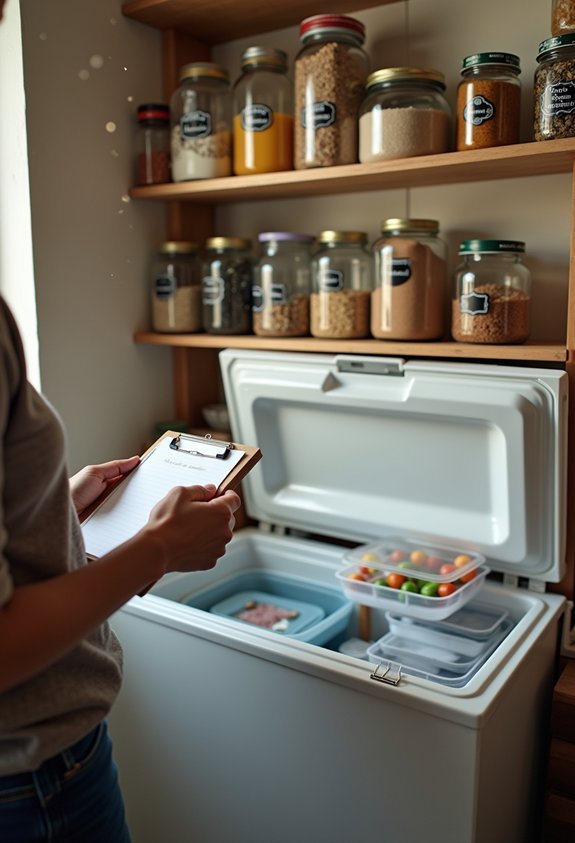
Most people discover about $60 worth of forgotten food living rent-free in their kitchen—which is basically like finding three twenty-dollar bills wedged behind your couch cushions, except these twenties are shaped like a can of chickpeas and that bag of quinoa you bought when you were feeling ambitious.
Every Sunday, I spend ten minutes doing pantry organization and freezer management—literally just staring into both until I remember what’s actually there.
This simple habit stops me from buying duplicate items at the grocery store (because apparently I’ve purchased tomato paste four separate times without realizing it).
Plus, when you know what ingredients you already have, meal planning becomes stupidly easy.
You’ll build meals around existing food instead of letting perfectly good stuff expire while you buy new things.
Decluttering your kitchen spaces also reduces visual noise that can keep your mind cluttered while you’re trying to make simple decisions about what to cook.
It’s free money, just sitting there.
Set Spending Limits for Each Category This Week
Knowing what food you already own is great, but that knowledge means nothing when you’re standing in Target with a cart full of things you definitely don’t need—which is why you need spending limits before you ever leave the house.
Effective budgeting strategies start with honest category allocation. Every Sunday, I assign dollar amounts to each spending area for the upcoming week:
- Groceries: Usually $80-100 for my household
- Eating out: A modest $30 (because let’s be real, sometimes you need those tacos)
- Entertainment: Around $20 for coffee dates or streaming rentals
- Miscellaneous: $25 for life’s little surprises
Once those numbers are set, they’re non-negotiable. It’s like giving yourself permission to spend—but only within boundaries that actually protect your bank account from your impulsive self.
Before making any purchase throughout the week, I ask myself the key question: “Does this move me toward what I really want?” This simple filter helps me delay or skip expenses that don’t align with my personal financial goals, keeping my spending intentional rather than reactive.
Organize My Coupons and Check for New Deals

Because those spending limits you just set won’t mean much if you’re paying full price for everything, it’s time to wrangle those random coupons floating around in your purse, junk drawer, and—let’s be honest—probably still stuffed in last week’s grocery bag.
Spend fifteen minutes organizing them by expiration date (because discovering a $5-off coupon expired yesterday is basically heartbreak in paper form).
Then check your favorite store apps for new deals—most retailers release their weekly specials on Sundays.
Smart coupon strategies mean matching manufacturer coupons with store sales, which sounds complicated but really just means: buy the thing that’s already on sale AND use your coupon.
Deal tracking doesn’t require spreadsheets or advanced math.
Just snap photos of the best deals you find for easy reference while shopping.
You’ll actually use them this way.
Don’t forget to enroll in loyalty programs while you’re checking those apps—they can earn you 1–5% back on regular purchases before you even start stacking other deals.
Prepare My Work Outfits to Avoid Impulse Clothing Purchases
While you’re hunting down savings at the store, you’re probably bleeding money from your closet—specifically those “emergency” Target runs when you’ve got nothing to wear (even though your closet’s literally full).
Sunday outfit prep is my secret weapon against panic shopping. Here’s what works:
Planning your weekly outfits on Sunday prevents expensive panic purchases when you think you have nothing to wear.
- Check the weather and lay out five complete looks—including shoes, accessories, the whole deal.
- Identify gaps in your work outfit essentials before Monday hits (so you can shop intentionally, not desperately).
- Try everything on to avoid that 7am “nothing fits” meltdown.
- Steam or iron now because wrinkled clothes trigger “I need something new” spirals.
This simple routine’s saved my clothing budget hundreds of dollars. No joke—I used to drop $50 weekly on “just one shirt.”
Now? My wallet actually stays closed.
When I do identify a genuine clothing need, I add it to a 30-day list rather than rushing to buy it immediately, which helps me distinguish between real wardrobe gaps and impulse desires.
Fill Up My Gas Tank When Prices Are Lower

Gas prices play mind games with your wallet—one day you’re paying $3.20, the next it’s $3.89, and suddenly you’re that person refreshing GasBuddy like it’s your favorite social media app.
Here’s what I’ve learned: gas price trends follow patterns. Prices typically drop Sunday evenings through Wednesday mornings, then climb toward the weekend when everyone’s road-tripping.
So every Sunday, I check local stations and fill up when it’s cheaper. Even saving 30 cents per gallon adds up—that’s $4.50 on a 15-gallon tank.
Real talk? This pairs perfectly with fuel efficiency tips like keeping your tires properly inflated and avoiding aggressive acceleration (yes, we see you, speed racer).
It’s not glamorous, but these Sunday fill-ups have genuinely saved me hundreds annually. When you track expenses for three months, you start seeing exactly where small weekly savings like this actually move the needle on your overall budget.
Worth it.
Pack Snacks and Coffee for the Entire Week
Speaking of Sunday routines that save money—let me introduce you to my meal prep‘s less glamorous cousin: the Sunday snack-and-coffee prep session.
Meal prep gets all the glory, but Sunday snack-and-coffee prep is the unsung hero of staying on budget.
Here’s what I do every week:
- Brew a week’s worth of cold brew (way cheaper than daily café runs)
- Portion almonds, pretzels, and fruit into containers for grab-and-go ease
- Pre-make energy balls or muffins that’ll actually get eaten
- Set up a simple coffee storage system with my favorite creamer ready
The secret? Smart snack organization means you’re not desperately buying overpriced granola bars at 3 PM.
I spend maybe thirty minutes doing this—and it saves me roughly forty dollars weekly.
That’s two hundred bucks a month that stays in my account instead of disappearing into vending machines and drive-throughs.
This system also helps me avoid impulse buying when stress or boredom hits during the workday—two of the most common emotional triggers that drive unnecessary purchases.
Your future self will thank you.
Review My Subscriptions and Cancel What I’m Not Using

Everyone’s got at least one subscription they forgot existed—probably charging away quietly in the background like a financial ninja you never agreed to hire.
Sunday’s the perfect time to hunt down those sneaky subscription services and decide what stays and what goes.
Pull up your bank statement and start scrolling. That meditation app you used twice? Gone. The streaming service you signed up for one show? Also gone.
Most phones have built-in app management features that’ll show you what’s linked to your account—use them. You’ll be shocked how quickly those $4.99 charges add up to actual money.
And here’s the thing: canceling doesn’t mean forever. You can always resubscribe when you’ll actually use it.
Clean Out My Fridge to Use Up Leftovers
That mystery Tupperware in the back of your fridge? Yeah, we need to talk about that. Sunday’s the perfect time to dig through everything before it becomes a science experiment.
Here’s your game plan:
- Pull everything out and check expiration dates.
- Group similar items together for better fridge organization.
- Plan Monday’s dinner using what needs eating first.
- Search “leftover recipes” for that random half-onion and lonely chicken breast.
You’ll be amazed how much money you’re literally throwing away each week. Those wilted veggies? Toss them in a stir-fry. That sad-looking cheese? Perfect for quesadillas.
Think of it as a treasure hunt—except the treasure isn’t wasting twenty bucks on groceries you already bought.
Your wallet will thank you.
Schedule Time Blocks for No-Spend Activities

Now that you’ve freed up some grocery money, let’s protect it from your weekend boredom spending.
Sunday’s the perfect time to block out no-spend activities for the week ahead—because an empty calendar is basically an invitation to Target.
I’m talking about scheduling your budget friendly hobbies like they’re actual appointments.
Monday evening? Book club at home.
Wednesday night? That hiking trail you keep meaning to try.
You may also like:





The trick with no spend challenges isn’t deprivation—it’s crowding out the expensive stuff with things you actually enjoy (but forgot existed).
When your calendar’s full of free fun, you won’t feel like you’re missing out.
Plus, committed time beats willpower every single time.
In case you were wondering
How Much Money Can I Realistically Save per Month With Sunday Prep?
You’ll realistically save $200-400 monthly through Sunday prep by implementing smart grocery planning and monthly budgeting. Your savings depend on family size and current spending habits, but most people cut food waste and impulse purchases significantly with consistent preparation.
What if I Don’t Have Time on Sundays for All These Tasks?
You can split tasks between Saturday and Sunday or choose weekend alternatives that fit your schedule. Focus on time management by tackling just two or three high-impact prep activities instead of attempting everything at once.
Can These Strategies Work for Families With Young Children?
Yes, they’re perfect for families! You’ll find family meal planning prevents costly takeout runs, while budgeting activities teach kids valuable money skills. Involve children in age-appropriate tasks like coupon clipping or creating shopping lists together.
How Do I Stay Motivated When I Miss a Sunday Routine?
Don’t let one missed Sunday derail your entire ship. You’ll stay motivated by practicing self compassion strategies and viewing this as overcoming setbacks—just restart next Sunday. Progress isn’t perfect; it’s about consistency over time.
What Apps or Tools Make Sunday Money Prep Easier?
You’ll find budgeting apps like Mint or YNAB streamline your Sunday planning perfectly. Expense trackers such as PocketGuard or Goodbudget help you categorize spending quickly. They’ll automate calculations, so you’re spending less time crunching numbers and more time saving money.
Conclusion
Look, you don’t need to do all thirteen things every Sunday—that’s a lot, and you’ve got a life to live. Start with just two or three that feel doable, maybe meal planning and checking your subscriptions. Here’s the thing: what if saving money didn’t feel like punishment but like giving yourself options? Small Sunday habits add up to real freedom during the week, and honestly, that’s worth an hour of your weekend.